
In the Markets Now: War in Iran
A Fluid Situation
Let’s begin with the obvious caveat – we don’t know what comes next for the ongoing conflict in Iran. Past geopolitical conflicts offer a broad (and often positive) outline for how markets may respond over the longer-term, but the range of outcomes is wide. And even if history says stock market returns are typically solid 3-, 6-, and 12-months following big geopolitical events, that doesn’t mean the next several weeks can’t get more uncomfortable first – particularly if oil remains on its current (parabolic) trajectory. Not to state the obvious, but it seems to us that markets are most unsettled by both the breadth of the conflict and the uncertain timeline for resolution. Investors have grown accustomed to geopolitical flare‑ups (and for that matter, general market selloffs) that ultimately prove short-lived V-shaped rebounds. Buying the dip has not just been successful in the post-2008 Financial Crisis crisis era, but has often been rewarded quickly. That’s never a guarantee.
The White House
And no doubt, investors’ assumption that the administration would rapidly respond to market and economic strain almost certaintly contributed to some complacency in markets. It’s still possible (and maybe even likely) that the administration capitulates to the negative impact that the war in Iran is having on oil prices, consumers, and financial markets (ala Liberation Day), particularly in a mid-term year. But it’s far from guaranteed given the additional complexity that comes with any geopolitical conflict.
Oil
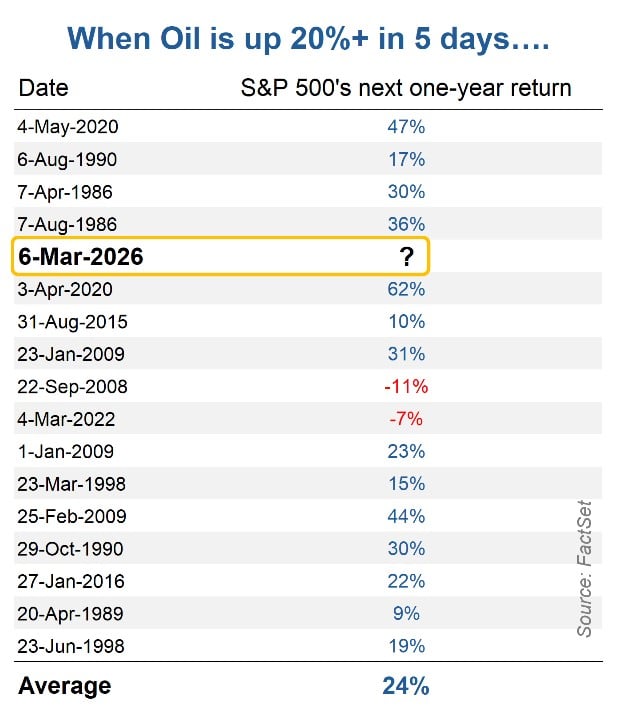
As we wrote this week, the primary way that geopolitical crises abroad impact U.S. investors and consumers is via the price of oil. A sustained spike in oil is the worst of many worlds – higher oil and gas prices can almost immediately tighten consumer spending, push inflation numbers higher (forcing the Fed to the sideline at a time when rate cuts were widely antipated), and pressure corporate profits. The U.S. produces more natural gas and crude oil than any other country, which may leave price shocks less detrimental than the stagflation 1970s. But that doesn’t insulate the U.S. from the pain of higher oil prices – especially at a time where economic anxiety is already elevated. As for markets, spikes in oil prices are less damaging long-term than one might assume on face. We identified the major short-term oil spikes of the last 40+ years and looked at how the market responded – ultimately, even sharp oil spikes historically fade once the market gains confidence that supply continues to flow (often faster than investors expect). But again, the impact will depend on the depth and breadth of the conflict.
Long-term Effect
Ultimately, history suggests even sharp geopolitical shocks tend to fade in magnitude unless they alter the longer-term global growth or inflation outlook. Apologies for reiterating a point (hopefully) already made, but a majority of major post-WWII political conflicts involving the U.S. saw the stock market higher just six months later. History rarely repeats, but it often rhymes. And while the headlines are quite scary, the severity of the rhetoric doesn’t change the bottom line for investors.
We’ll never recommend changing a strategy, allocation, or investment plan – particularly one geared towards long-term goals – over geopolitical conflict. The history of the stock market is one where innovation and profit growth (incentivized at every turn by the gears of capitalism) tend to win out over short- and medium-term disruptions. If you asked me whether artificial intelligence or oil prices would be more important for the stock market in March 2027, I’d almost certainly say AI. But we are also not ignorant to the ways in which the world has changed over recent years. Deglobalization is a theme that our partners at Strategas, a Baird Company, have been discussing in depth for some time, with obvious implications for asset allocation (that they detail here). We will continue to monitor the situation closely. In the meantime, we’d not hesitate to remind our clients to reach out to their Baird Financial Advisor team with any questions related to their own portfolio and circumstances.
Disclosures
This is not a complete analysis of every material fact regarding any company, industry or security. The opinions expressed here reflect our judgment at this date and are subject to change. The information has been obtained from sources we consider to be reliable, but we cannot guarantee the accuracy. Market and economic statistics, unless otherwise cited, are from data provider FactSet.
This report does not provide recipients with information or advice that is sufficient on which to base an investment decision. This report does not take into account the specific investment objectives, financial situation, or need of any particular client and may not be suitable for all types of investors. Recipients should not consider the contents of this report as a single factor in making an investment decision. Additional fundamental and other analyses would be required to make an investment decision about any individual security identified in this report.
For investment advice specific to your situation, or for additional information, please contact your Baird Financial Advisor and/or your tax or legal advisor.
Past performance is not indicative of future results and diversification does not ensure a profit or protect against loss. All investments carry some level of risk, including loss of principal. An investment cannot be made directly in an index.
Copyright 2026 Robert W. Baird & Co. Incorporated.
Other Disclosures
UK disclosure requirements for the purpose of distributing this research into the UK and other countries for which Robert W. Baird Limited holds an ISD passport.
This report is for distribution into the United Kingdom only to persons who fall within Article 19 or Article 49(2) of the Financial Services and Markets Act 2000 (financial promotion) order 2001 being persons who are investment professionals and may not be distributed to private clients. Issued in the United Kingdom by Robert W. Baird Limited, which has an office at Finsbury Circus House, 15 Finsbury Circus, London EC2M 7EB, and is a company authorized and regulated by the Financial Conduct Authority. For the purposes of the Financial Conduct Authority requirements, this investment research report is classified as objective.
Robert W. Baird Limited ("RWBL") is exempt from the requirement to hold an Australian financial services license. RWBL is regulated by the Financial Conduct Authority ("FCA") under UK laws and those laws may differ from Australian laws. This document has been prepared in accordance with FCA requirements and not Australian laws.